
VOCABULARY - THE BEDROOM
TAGLIAVINI SUSANNA • 16 giugno 2026
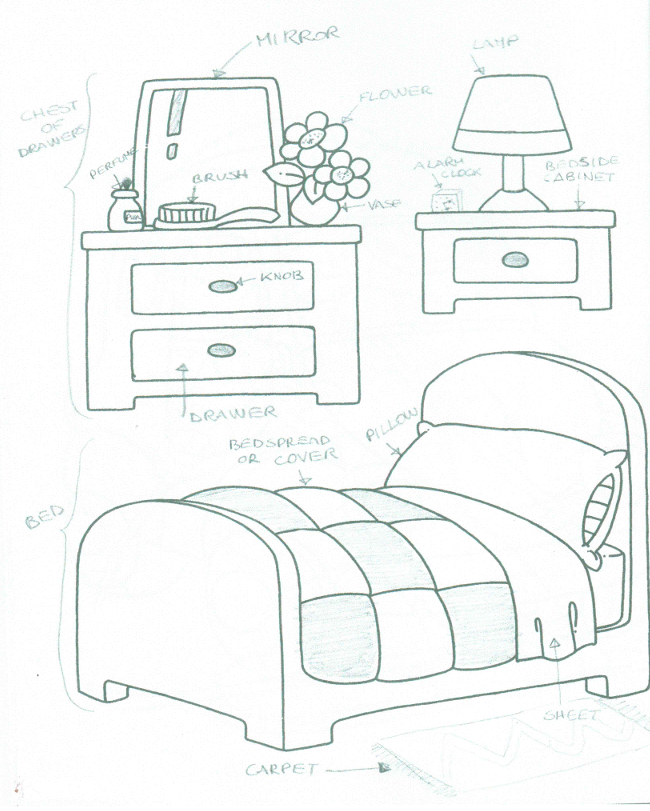
Mirror: Specchio
Flower: Fiore
Lamp: Lampada
Perfume: Profumo
Brush: Spazzola
Vase: Vaso
Alarm clock: Sveglia
Bedside cabinet: Comodino
Knob: Pomello
Drawer: Cassetto
Chest of drawers: Cassettiera
Bedspread or cover: Copriletto
Pillow: Cuscino
Sheet: Lenzuolo
Bed: Letto
Carpet: Tappeto
The history of Britain is fascinating and interesting, and hopefully with this section you will learn to love it too. You could think that you don't like history: maybe you didn't like it even at school! However , understanding the history of a country will help you to understand the British people and its language. In fact, how many of you want to know why English has such a difficult pronunciation? Do you know why today English, Welsh , Scottish and Irish are languages so different from one another? Would you like to know who the Celts were? Do you know where the first inhabitants of Britain came from? By reading this section you will know, because our voyage around the centuries will join the history of Britain and the history of the English language. So, let's start our ride ! THE BEGINNINGS - THE IBERIANS Of course, like all European Countries, there was a time when there were no inhabitants in Britain, and the island was a green, luxuriant land full of thick forests, water, game and fish, and with a mild climate. However, man has always wanted to discover new things and places, and about 2000 years before Christ the first men arrived by sea on the British island; Where did they come from? You'll probably never guess it, but the first inhabitants were the Iberians, so called because they probably came from Iberia, that is , the modern Spain. The southern and eastern coasts of Britain are low, have good natural harbours and also have navigable rivers; The western and northern coasts are not so accessible, so we assume that the Iberians arrived on the southern coasts. The Iberians were short , had dark hair and lived in the western and southern parts of Britain because they didn't have many tools and couldn't penetrate the thick forest present in the rest of the island. The lands where they lived weren't very fertile in comparison with the rest of Britain, especially because they were uplands, that is, mountainous regions. However, the Iberians were probably very good at agriculture because they terraced the hills (some of these terraced hills can still be seen today in Britain), and cultivated different kinds of cereals, using the hoe and the spade . They also bred goats , oxen and pigs, but were also hunters and were good at weaving and at building .

INDEFINITE ARTICLES (ARTICOLI INDETERMINATIVI) NOZIONI BASILARI In inglese esiste di fatto un unico articolo indeterminativo per i nomi maschili, femminili e neutri, che è " A " (pronuncia "æ", una via di mezzo tra una a e una e). " AN ", l'altro articolo indeterminativo, si usa davanti a nomi sia maschili, sia femminili che neutri, che iniziano per vocale, secondo le regole enunciate qui di seguito: A - nomi che iniziano per consonanti (a pen, a cat, a dog)- nomi che iniziano per H aspirata (a hotel, a house), perché in inglese “h” è una consonante- nomi che iniziano per W e Y (a watch, a wall, a year, a yard)- nomi che iniziano per U quando si pronuncia "iu" (a university, a uniform)- nomi che iniziano per dittonghi (un dittongo è formato da due vocali in cui l'accento cade sulla seconda vocale): a European, a eunuch. Di fatto, anche W (che si pronuncia come una “u”) e Y concorrono sempre a creare dittonghi, ed è per questo che davanti a parole che iniziano con queste due lettere si mette "A". AN - nomi che iniziano per vocale, tranne quelli che iniziano per "U" pronunciata "iu": an egg, an apple, an orange- nomi che inizano per "H" muta: an hour, an honest man* * le parole che hanno "H" muta in inglese sono molto poche: hour, honour, honest, heir (erede), e i derivati di tali parole (per esempio honourable). In linea di massima, l'uso degli articoli indeterminativi in inglese è lo stesso dell'italiano, quindi davanti a nomi singolari. *le parole che hanno "H" muta in inglese sono molto poche: hour, honour, honest, heir (erede), e i derivati di tali parole (per esempio honourable). In linea di massima, l'uso degli articoli indeterminativi in inglese è lo stesso dell'italiano, quindi davanti a nomi singolari. DEFINITE ARTICLE (ARTICOLO DETERMINATIVO) In inglese esiste un unico articolo determinativo: "THE", che corrisponde ai nostri: il, lo, la, i, gli e le. Benché non esista un articolo specifico per nomi che iniziano per vocale o H muta, bisogna sottolineare che c'è è una differenza di pronuncia dell'articolo THE : - si pronuncia "ðə"* davanti alle stesse parole che corrispondono all'articolo indeterminativo "A" (vedi sopra): the pen = ðə pen - si pronuncia "ði" davanti alle stesse parole che corrispondono all'articolo indeterminativo "AN" (vedi sopra): the egg: ði egg * "ð" è il simbolo fonetico che traslittera il suono inglese "TH": si pronuncia pizzicando la lingua in mezzo ai denti e soffiando come se si volesse imitare il sibilo di un serpente, e sonorizzandolo in gola.
This is a subtitle for your new post


